The Five Levels of Idea Validation And Why Most Founders Stop at Level 1
Most founders believe they've validated their idea. They haven't. They've had misleading conversations.
There's a difference between someone saying "that's interesting, I'd use that" and someone wiring you money. One makes you feel good. The other makes you a business.
A founder recently presented a pitch claiming "validated demand from 40 customer interviews." When asked what the strongest signal was, the answer came back: "They all said they'd buy it when it's ready."
That's not validation. That's politeness.
People are generous with enthusiasm and stingy with budgets. Telling a founder "I'd buy that" costs nothing. It's the easiest thing to say in a meeting. It ends the conversation faster than "I'm not sure this solves my problem."
## The five levels
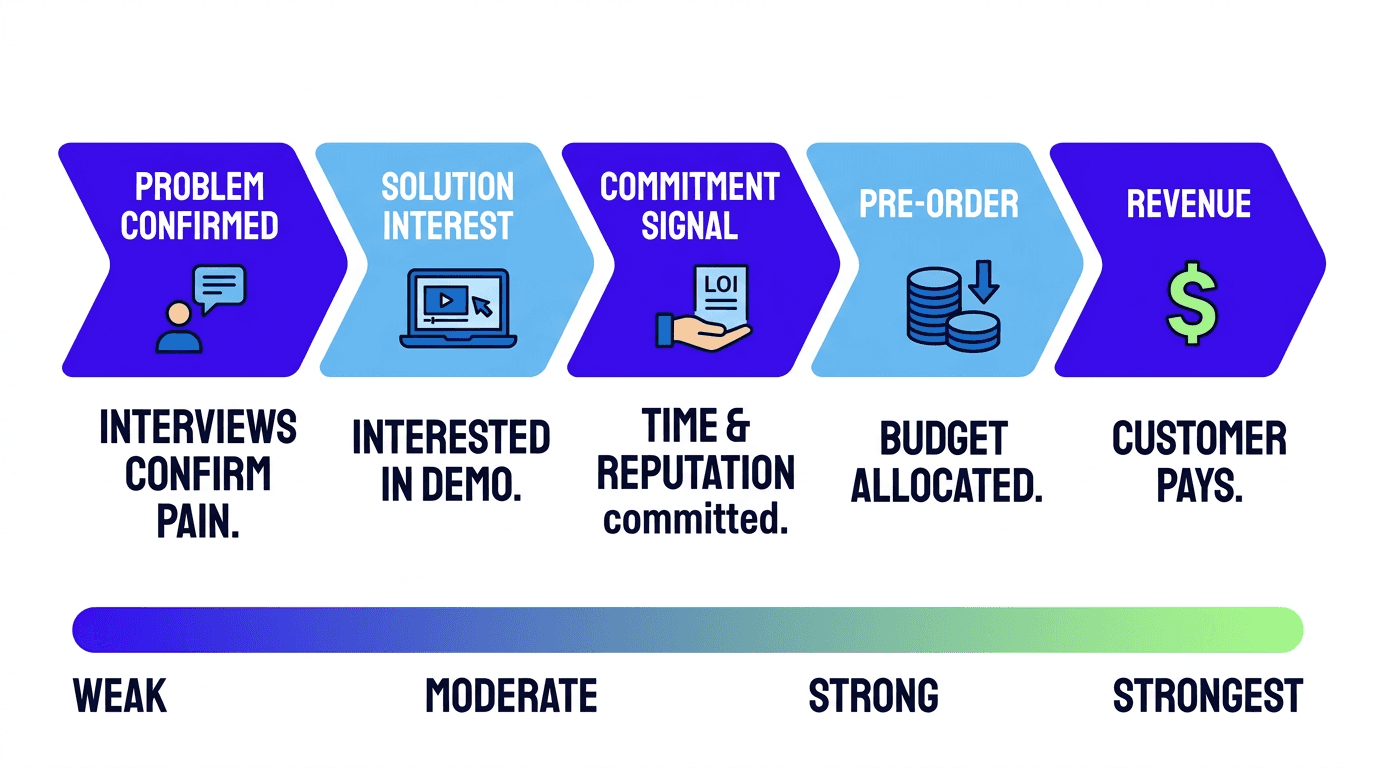
After working with hundreds of startups at every stage, a pattern emerges. Validation isn't binary — it exists on a spectrum. Most founders celebrate at Level 1 and start building. The ones who survive tend to push to Level 3 or 4 before they write serious code.
Level 1: The problem exists
Customers confirm the pain is real. This is where most "validated" ideas live. But confirming a problem exists is almost meaningless — everyone has problems. The question isn't whether the pain is real. It's whether it's bad enough that someone will change their behaviour to fix it.
Level 2: Solution interest
A demo or concept is shown and people lean in. They ask questions. They say "this is interesting." This feels like progress, and it is — but interest and intent are not the same thing. Interesting gets a second meeting. Intent gets a customer.
Level 3: Commitment signals
A letter of intent. A pilot agreement. A waitlist signup. The customer is putting their time or reputation on the line. They're telling their manager about it. They're blocking calendar time. This is the first level where real demand signal appears, because there's a cost to saying yes.
Level 4: Money is allocated
A signed paid pilot. A pre-order with a deposit. Budget carved out of someone's quarterly plan. When a customer commits money — even small amounts — they've made a decision that required internal justification. They had to explain to someone why this matters.
Level 5: Revenue
Someone paid for the product and is using it. The only level that's unambiguous.
Where founders get stuck
The gap between Level 2 and Level 3 is where most startups stall without realising it. They accumulate a pile of "great conversations" and a pipeline full of people who were warm and encouraging in meetings. They interpret warmth as demand. Then they spend six months building, launch, and wonder why nobody signs up.
The fix is simple but uncomfortable: ask for something before building. Not feedback. Not opinions. A commitment that costs something — time, money, reputation. If the prospect hesitates, that's data. If they say "let me think about it," that's data too. And it's more useful data than "yeah, I'd definitely use this."
This doesn't mean revenue is required before building anything. But honesty about which level the evidence actually supports changes everything.
"40 interviews confirmed the problem" is Level 1. A starting point, not a finish line.
Before the next standup or board update, the question worth asking is: what's the strongest validation signal that actually exists? Not the one that sounds best in a deck. The real one.
If the answer is "people told us they like the idea" — that's not validation. That's a collection of misleading conversations.
---
Have a startup idea you can't stop thinking about — but can't seem to move forward? Go No Go takes you from idea to first paying customer in 12 weeks. While you keep your job. [Book a call](https://calendly.com) or visit [gonogo.vc](https://gonogoprogram.com) to get started.